Why study a dead language? Daily, this question bombards Classics students around the world. For many Classics students, it’s essentially a personal attack on our work and an integral part of us. But no matter how much we despise this question, it is valid. This question itself is predicated upon utility, it judges the utility of a certain skill and deems anything without visible practicality useless. A surface-level assessment would lead to the conclusion that the Classics is futile, but when you dive a little deeper there is a lot of hidden utility. My mission is to convince others of the Classics’s utility and that it is still relevant, thus answering the age-old question, and that everyone should study it.
Returning to the question, “Why study dead languages or ancient cultures?” Rome and Greece not only laid the foundation for many of our modern languages, they laid the foundation for much of Western culture. And if we fail to recognize and study our beginnings in Rome and Greece we will forfeit the opportunity to leverage the knowledge of our predecessors and to understand ourselves better, preventing or slowing our forward progression.
The first important aspect of Rome and Greece’s legacy is the language itself since languages like English and Spanish are derived from Latin and Greek. Students who study and immerse themselves in the Classics develop a more thorough understanding of other languages. Many individuals are skeptical of Latin and Greek due to their lack of obvious application in the field of interpersonal communication; however, this is a misconception. Although they don’t permit one to speak an active language, it does help one elevate their English or romance language skills. Understanding the roots and etymology of words aids students in learning new or complex vocabulary and in retaining them. Comprehension of Latin and Greek, in particular, provides you with the skills to derive a word’s meaning based on its roots. For example, one of the first English words I learned employing this method was ‘ameliorate’. When I first saw this word I wondered, “What did Amelia have to do with this? Who even is Amelia?” At first, it seemed daunting, but if you break down the Latin roots it derives from the comparative, melior, -ius, meaning better. Applying this definition leads us to the conclusion that ameliorate, more or less, means to make something better. So for a Latin student, a complicated word can become simple and easy to digest. This language superpower is not only limited to Latin, recently in our English class we were exploring poetry and discussing various poetic devices. To a casual reader, the word ‘polysyndeton’ may spark immediate anxiety. But Greek students need not fear, knowing that Polysyndeton is made up of two simple parts: poly and syndeton. Poly means ‘many’ and syndeton roughly ‘bound together,’ referencing conjunctions, literally translating to ‘many conjunctions’. And true to its etymology, the poetic device polysyndeton is the repetition of conjunctions. In this way Latin and Greek can help you identify, learn, and build up an extensive linguistic arsenal.
Second reason: The study of the Classics opens the door to an entire world of Western culture, especially art, that can otherwise seem out of reach. When I was lucky enough to have an opportunity to travel to the Louvre, I found myself in their extensive sculpture collections. These collections were, of course, filled to the brim with the most exquisite pieces, the vast majority of which were not only in a Classical style but were also about Classical mythological characters. Although it would be preposterous to argue that those who are unfamiliar with all the stories and characters are incapable of enjoying these masterpieces, those who understand the stories behind the works have a whole different perspective that allows them to fully appreciate it.
Lastly, in a world that is increasingly politicized and polarized, it has become imperative for students to be more informed about our political system. The Classics provide a great jumping-off point for this endeavor. The idea of politics itself originates in Greece, with the word coming from πολις. And we can use Greek history to better inform our political decisions, as history always repeats itself. Although democracy and, later, the republic are the best forms of government to exist, they have weaknesses that can be seen in ancient Rome and Greece. Many are concerned about, essentially, what is corrupt modern-day demagogues and mob rule, a serious problem in the Athenian democracy. Others about the breakdown of government power balance, and the downfall of the Roman Republic. These are all crises that people long before us have faced, some have failed, while others have succeeded, regardless, the method of handling provides invaluable information to us, who are facing these issues right now.
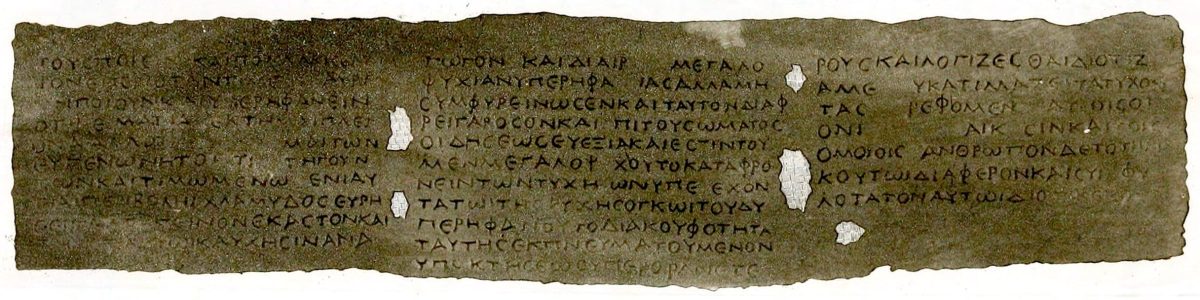
Cover Photo: Carbonized paper, found with other images in an 1858 published book by Giacomo Castrucci.