Today, millions tune in to NASCAR races, watching drivers speed around the track at hundreds of miles per hour. These viewers are part of what has become a massive, multi-billion-dollar cultural phenomenon.
The significance of racing though, is nothing new. Thousands of years ago, Greeks and Romans raced horse-drawn chariots for entertainment. According to some sources, chariot racing was one of the first events in the inaugural Olympic Games almost 3,000 years ago. It would become common in many Greek religious festivals, which also included the important panhellenic games. As Greek influence spread to Rome, so did chariot racing.
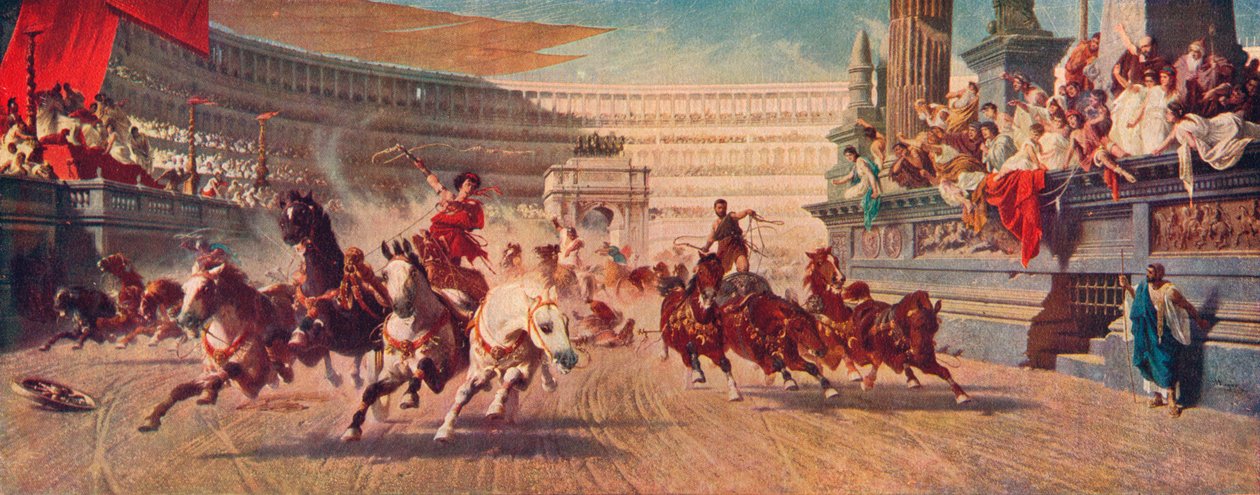
Roman chariot racing began in the Circus Maximus, one of the largest ancient stadiums. It boasted an initial capacity of over 150,000 and was expanded many times after. Both the Romans and Greeks primarily used chariots drawn by teams of four or two horses. Normally, there would be four factions, racing teams, competing in each race: blue, green, red, and white. These teams would race 7 laps around the Circus Maximus’s oval track. It was by no means an easy race though, not only was competition fierce, injury was common. Too often, drivers would find themselves tangled in reins and dragged along in nasty, sometimes fatal, crashes called shipwrecks. But these races would persist into the 6th AD, not ending till a century after the fall of the Western Roman Empire in Rome and not until the races got too out of hand in Constantinople. Their longevity is largely due to the significant cultural role they played. The races were a critical part of Rome’s plan of bread and circuses and the factions played an important political function.
The factions—red, blue, green, white, and, briefly, gold and purple—acted as political groups and clubs, especially in Constantinople. Juvenal said that when the Greens lost, Rome became downcast like a national defeat had occurred. In the East, the Blues and Greens were the powerful factions and had significant political sway. Officials would often be part of the factions and lend personal support, making the factions a proxy for political battles. Faction-initiated riots sometimes became violent, the primary example being the Nika riots of 532 which ended in military deployment and the deaths of tens of thousands of rioters. They also played roles in religious disputes post-Christianization as splits on doctrine were reflected in the split between the Blues and Greens. The racing factions functioned much like modern political parties in the U.S., though their influence was centered on chariot racing rather than policy—a fascinating and unique phenomenon.
Cover Photo: A Roman Chariot Race, c1882. by Alexander von Wagner