A little while back, I completed a project about beer and its role in modern China. That research sparked my curiosity about the place of beer in the ancient world and how ancient traditions continue to influence drinking culture today.
Firstly, in 20th century China, beer was viewed as a drink of the more progressive, but it was not so in ancient Rome. While beer certainly existed in the ancient world, it was by no means the choice drink for the civilized Roman. Beer was viewed as a drink only consumed by barbarians, who were the only ones brewing it, whereas wine was the good Roman’s drink. This would even continue post-conversion
As the Roman Empire continued to grow and expand, it carried its wine-loving culture with it. In regions like Spain and France, before the arrival of the Romans, indigenous populations consumed beer, but the introduction of wine changed everything. The local drinking culture shifted significantly, laying the foundation for the wine traditions that endure to this day. Today, these two countries continue to boast robust wine-drinking cultures with wines sold around the world.
Believe it or not, Christianity also played a role in the proliferation of wine as the drink of the Romans. Constantine’s ascension to power brought an empire-wide conversion to Christianity, which has inextricable ties with wine consumption. A key component of the faith is communion, which is ritual consumption of wine and bread. Wine consumption at communion definitely supported the strengthening of wine culture throughout the empire. The miracle of turning water into wine and the central role of wine at the Last Supper likely also played a significant role.
As the Roman Empire and its former territories entered the medieval period, there was a deeply ingrained wine culture, the presence of which can still be seen today. In many former Roman territories, wine remains the drink of choice, particularly in regions that were under Roman rule for extended periods. Countries like France, Spain, Italy, and parts of the Near East today have very healthy wine cultures. In contrast, consider Germany, where Roman influence was limited to Caesar’s brief incursion; today, there is a beer culture in Germany that is just as strong as the wine culture in southern Europe. Similarly, Britain, which had only a mild Roman presence, has developed a balanced culture of both beer and wine. It’s fascinating how the Roman Empire’s cultural imprint continues to shape Europe’s drinking habits: countries that prefer beer tend to be those beyond the Empire’s lasting reach, while those with strong wine cultures were often longstanding parts of it.
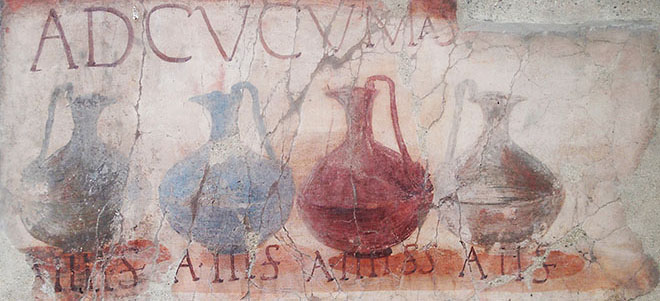
Image caption: A shop sign from Herculaneum, advertising the prices of different wines. Image credit: Paula Lock.